
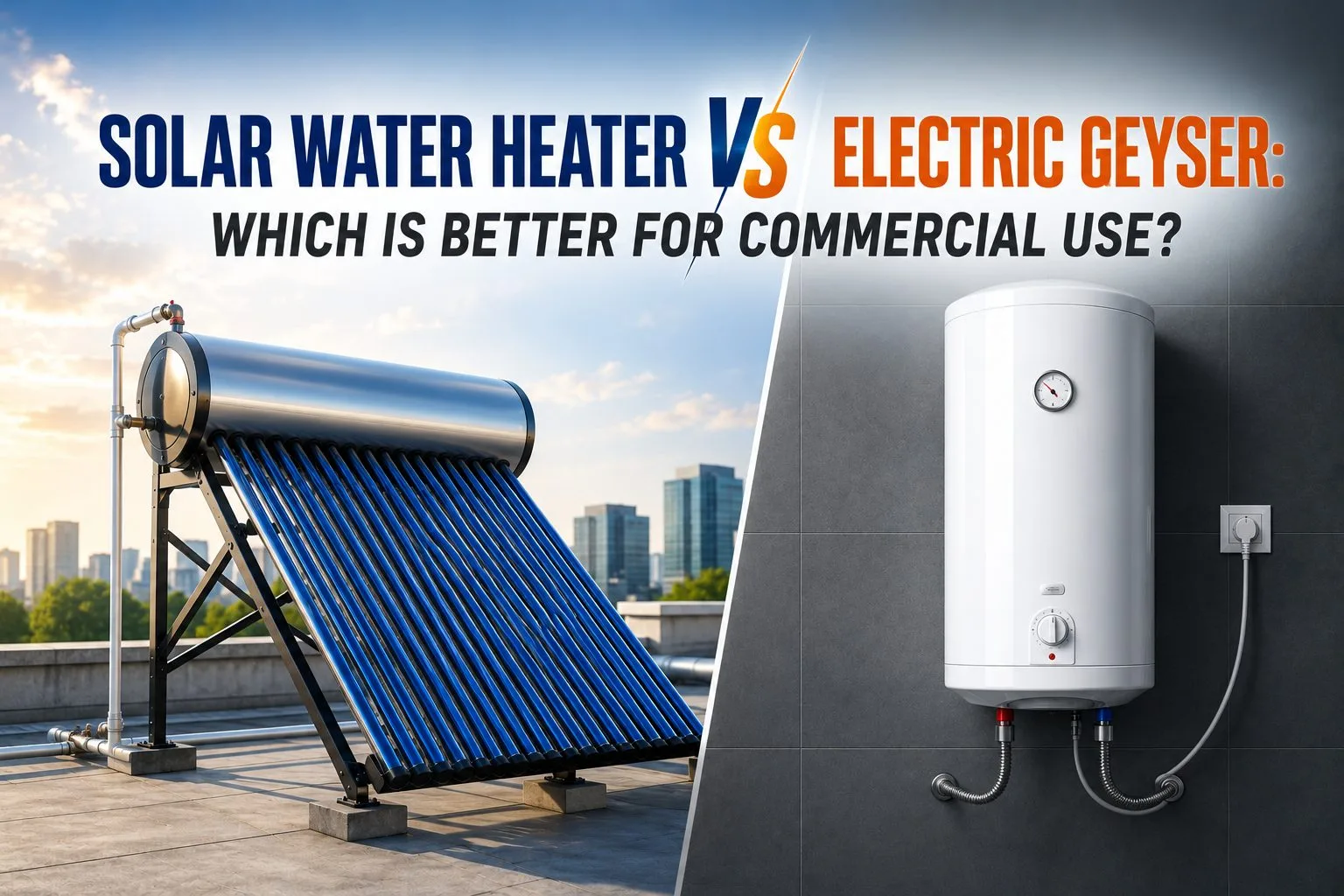
Modern commercial facilities such as hotels, hospitals, and restaurants rely heavily on continuous hot water supply. But this critical utility comes with a hidden challenge: rising energy costs and the risk of system failure during peak demand. Choosing between a solar water heater vs electric geyser is one of the most impactful energy decisions a commercial facility manager can make. The wrong choice can silently drain thousands in operating costs every year. The right one can cut utility bills in half and provide decades of reliable service.
According to the International Energy Agency (IEA), solar thermal heating is among the most cost-effective renewable energy technologies available today — and commercial adoption is growing rapidly worldwide.
This is where selecting the right water heating system becomes a practical solution. It is not just about heating water. It is about ensuring reliability, reducing costs, and maintaining smooth daily operations.
This guide covers how solar water heater vs electric geyser work, how they compare across energy cost, performance, installation, and lifespan, and which system is the right fit for different commercial applications.
Quick Answer
Solar water heaters reduce energy costs by 50–70% and are ideal for large commercial facilities. Electric geysers deliver instant, weather-independent hot water and work best as primary or backup systems for smaller operations. For most commercial setups, a hybrid approach delivers the best results.
What Is a Solar Water Heater?
A solar water heater is a thermal system that captures sunlight and converts it directly into heat energy to warm water. Unlike solar PV panels that generate electricity, solar water heaters use the sun’s heat directly — making them significantly more efficient specifically for water heating purposes.
Riwatt Solar’s commercial-grade systems, including flat plate solar collectors and evacuated tube collectors, are engineered for high-volume daily output in demanding commercial environments.
Key components include:
- Solar Collector Panels: Mounted on rooftops or open areas, these absorb sunlight and convert it into thermal energy. Proper angle and orientation are critical for maximum efficiency.
- Insulated Storage Tank: Stores heated water at temperature for hours without additional energy input, ensuring supply is available even after sunset.
- Circulation System: Pumps and piping that move water between the collector and tank. Available in passive (thermosiphon) and active (pumped) configurations.
- Support Structure: Tilt-adjustable mounting frames designed to optimize sun angle exposure throughout the year.
Environmental Benefit: A single commercial solar water heating installation can offset between 1.5 to 3 tonnes of CO₂ per year. This supports corporate sustainability goals and may qualify for government incentive programs in many countries. The International Renewable Energy Agency (IRENA) recognizes solar thermal as one of the most accessible clean energy technologies for commercial buildings.
What Is an Electric Geyser?
An electric geyser is a water heating device that uses electricity to heat water. It is commonly installed inside bathrooms or utility areas.
Here’s what it’s made of:
- Heating Element: This converts electricity into heat to warm the water.
- Storage Tank (or Instant Unit): Stores hot water or heats it instantly when needed.
- Thermostat: Controls the temperature and prevents overheating.
- Outer Body: Covers and protects internal components.
Electric geysers are easy to install and do not require large space. They provide instant and consistent hot water. They are commonly used in homes and small commercial setups.
Solar Water Heater vs Electric Geyser: A Detailed Comparison
Both solar water heaters and electric geysers are widely used water heating systems in residential and commercial applications. However, the solar water heater vs electric geyser difference becomes most visible in energy source, efficiency, installation, and long-term performance. The following comparison highlights their key technical and practical differences.
Heating Performance & Output
Water heating performance depends on energy source, system design, and usage capacity. In the solar water heater vs electric geyser performance comparison, solar systems rely on sunlight while electric geysers use direct electrical heating.
| Solar Water Heater & Electric Geyser Heating Performance & Output Comparison | |||||
| Heating speed | Slow (sun dependent) | Fast / Instant | |||
| Output consistency | Weather dependent | Fully consistent | |||
| Daily capacity | High — 200L to 5,000L+ per system | Medium — typically up to 500L | |||
| Peak Demand Handling | Excellent with correct sizing | Limited by tank size | |||
| Night-Time Supply | From insulated storage tank | On-demand at any time | |||
Solar systems are better suited for large-scale continuous usage, while electric geysers excel when instant, on-demand hot water is the priority.
Energy Consumption & Efficiency
Energy efficiency is a key factor in commercial selection. The solar water heater vs electric geyser efficiency gap becomes clear when you compare operating costs over 12 months.
| Solar Water Heater & Electric Geyser Energy Consumption & Efficiency Comparison | |||||
| Energy source | Free sunlight | Grid electricity | |||
| Operating cost | Very low (near-zero fuel cost) | High — significant electricity use | |||
| Efficiency level | 60–80% solar conversion | 90–95% electrical conversion | |||
| Energy Savings vs Baseline | 50–70% reduction | — | |||
| Grid Dependency | Minimal (backup only) | 100% grid dependent | |||
Industry Insight: According to IRENA, solar water heating systems in commercial applications typically achieve a payback period of 3–7 years, after which they generate essentially free hot water for 10–18 more years.
Installation Method
Installation requirements vary based on system design and space availability. Understanding the solar water heater vs electric geyser installation difference helps facility managers plan budgets and timelines accurately.
| Solar Water Heater & Electric Geyser Installation Method Comparison | |||||
| Installation type | Rooftop / external setup | Indoor wall-mounted | |||
| Installation time | 1–3 days (professional) | 2–4 hours | |||
| Space requirement | Significant roof/ground area | Minimal — fits in utility closet | |||
| Structural Requirements | Load-bearing roof assessment needed | None (beyond wall mounting) | |||
| Professional Required | Certified solar installer | Plumber or electrician | |||
Solar systems require roof space and proper orientation, while electric geysers are compact and easy to install.
Maintenance & Lifespan
The solar water heater vs electric geyser lifespan gap is significant. Solar systems last 15 to 25 years while electric geysers typically last 8 to 12 years.
| Solar Water Heater & Electric Geyser Maintenance & Lifespan | |||||
| Parameter | Solar Water Heater | Electric Geyser | |||
| Lifespan | 15 – 25 years | 5 – 10 years | |||
| Maintenance | Annual inspection recommended | Every 2–3 years | |||
| Repair frequency | Low | Moderate | |||
The longer lifespan of solar systems means they outlast 2–3 generations of electric geysers during their operational lifetime, making them a fundamentally better long-term investment.
Cost Comparison
Cost plays a major role in commercial decision-making. The solar water heater vs electric geyser cost comparison looks very different when you calculate total cost of ownership over 10 years rather than upfront price alone.
| Cost Category | Solar Water Heater | Electric Geyser |
| Initial Purchase | Higher (system complexity) | Lower (simple device) |
| Installation Cost | Moderate to high | Low |
| Monthly Operating Cost | Very low (near-zero fuel) | High (continuous electricity use) |
| 10-Year Total Cost | Lower overall | Significantly higher |
| Property Value Impact | Increases property value | Minimal impact |
Solar systems require higher investment but lower long-term cost, while geysers are cheaper initially but expensive over time.
ROI Analysis: Which Saves More Over 10 Years?
For commercial facilities, the financial case for solar water heating becomes compelling when you calculate total cost of ownership over a decade. The solar water heater vs electric geyser ROI comparison shows a clear winner for high-demand facilities. The U.S. Department of Energy estimates that solar water heaters can reduce water heating bills by 50 to 80 percent compared to conventional electric systems.
For a hotel consuming 2,000 litres of hot water daily:
| Cost Item | Solar System | Electric Geyser |
| Upfront Investment | Higher | Lower |
| Annual Energy Cost | Very low (backup only) | Substantial monthly bill |
| Maintenance Over 10 Years | Moderate | Moderate + unit replacements |
| Typical Payback Period | 3–6 years | No payback (ongoing cost only) |
| 10-Year Net Position | Significant savings | Ongoing high expenditure |
The key insight: in any solar water heater vs electric geyser cost analysis, an electric geyser never pays for itself. It is a permanent operating cost. A solar water heater, after its payback period, generates hot water at near-zero cost for the remainder of its 15 to 25 year lifespan.
Industry-Specific Recommendations
The best choice depends heavily on your facility type. Here is how different commercial sectors approach this decision:
Hotels & Resorts
High daily demand makes solar the clear winner for ROI. An electric backup handles peak or emergency needs. Riwatt’s large-capacity systems are purpose-built for the hospitality sector.
Hospitals & Clinics
A hybrid system is essential here. Solar handles base load while electric backup guarantees uninterrupted supply — critical for infection control and continuous patient care.
Restaurants & Cafes
Smaller footprint requirements suit electric instant heaters, but rooftop solar systems offer strong savings for restaurants with consistent daily operating hours.
Factories & Manufacturing
Process water heating can represent a major portion of operating costs. Large solar array installations deliver the fastest ROI in this segment due to high volume and predictable usage patterns.
Schools & Universities
Predictable usage schedules align perfectly with daytime solar output. Many institutions benefit from government grant programs that significantly reduce upfront costs.
Gyms & Sports Facilities
Peak shower demand in early morning and evening can be managed with solar storage tanks, with electric units covering off-peak gaps at minimal additional cost.
The Hybrid Approach: Getting the Best of Both
For many commercial facilities, the optimal solution is not choosing one system over the other. It is combining both. A hybrid solar water heater vs electric geyser delivers the energy efficiency of solar with the reliability guarantee of electric backup.
How it works: During daylight hours, solar collectors heat water and fill the insulated storage tank. The electric geyser remains in standby mode, consuming no energy. On cloudy days, at night, or during unusually high demand, the electric backup activates automatically ensuring guests, patients, or staff never experience a disruption. This approach typically captures 85 to 90% of potential solar savings while maintaining 100% uptime reliability.
Riwatt Solar engineers customized hybrid configurations for commercial clients worldwide. Our technical team can assess your facility’s daily demand profile and recommend the optimal solar to electric capacity ratio for your specific situation.
Solar Water Heater Vs Electric Geyser: Which One Should You Choose?
Understanding the solar water heater vs electric geyser difference helps commercial users select the right water heating solution for their needs.
Choose a Solar Water Heater if you:
- Operate a hotel, hospital, factory, or other large facility
- Have hot water demand exceeding 500 litres per day
- Have adequate rooftop or ground-level space
- Want to significantly reduce long-term energy costs
- Are committed to reducing your facility’s carbon footprint
- Are located in a region with reasonable solar irradiance
Choose an Electric Geyser if you:
- Need guaranteed instant hot water with zero weather dependency
- Have very limited installation space
- Need a backup system to complement an existing solar setup
- Operate a small facility with modest hot water requirements
- Have a constrained upfront capital budget
For most medium-to-large commercial operations, the solar water heater vs electric geyser answer is a hybrid system using solar as the primary source and electric as an automatic backup. Contact Riwatt’s commercial team to design a system tailored to your facility.
Why Should You Choose Riwatt Solar Co., Ltd?
Riwatt Solar Co., Ltd is a professional manufacturer of solar water heaters and solar collectors. Since 2009, our company has focused on innovation, developing advanced and patented solar heating solutions for global markets.
- 15+ Years of Experience: Deep expertise in solar heating research, system engineering, and commercial deployment
- 13+ New Patents Per Year: Continuous product innovation that keeps our systems ahead of the market
- Own Manufacturing Factory: Direct production ensures tight quality control and consistent output at every scale
- Full Product Range: From individual solar collectors to complete commercial water heating and pool heating systems
- Global Support: Technical documentation, installation guidance, and after-sales support for commercial clients worldwide
Riwatt Solar delivers innovative, reliable, and cost-effective solar solutions, helping businesses achieve better performance, energy savings, and sustainable growth.
Final Key Takeaways
- Commercial hot water demand is the primary factor in system selection
- Solar water heaters reduce long-term energy costs by 50–70% compared to electric
- Electric geysers ensure instant, weather-independent hot water — ideal as backup
- A hybrid system provides the best balance of efficiency and reliability for most facilities
- Solar systems last 15–25 years vs 8–12 years for electric geysers
- ROI for commercial solar installations is typically achieved within 3–6 years
- Proper installation quality directly affects both efficiency and long-term lifespan
Conclusion
The solar water heater vs electric geyser debate for commercial use comes down to your facility’s scale, budget horizon, and reliability requirements.
Solar water heaters are best for commercial users who want long-term energy savings and large-scale hot water supply. They are cost-effective over time but depend on sunlight and require higher initial investment.
Electric geysers are suitable for businesses that need instant hot water and reliable performance in all conditions. The best choice depends on usage needs, but a hybrid system often gives the most balanced results.
Overall, selecting the right system improves efficiency, reduces costs, and ensures smooth daily operations for commercial setups.
Ready to reduce your facility’s energy costs? Contact our commercial team today for a free consultation and customized system quote.
FAQS
1. What is the main difference in a solar water heater vs electric geyser for commercial use?
The main difference is energy source and operating cost. A solar water heater uses free sunlight and reduces heating costs by 50 to 70 percent. An electric geyser uses grid electricity and carries a permanent monthly operating cost.
2. Which system is better for large-scale commercial applications?
In the solar water heater vs electric geyser comparison for large-scale use, solar is the clear winner due to lower operating costs and longer lifespan. Electric geysers suit smaller setups or serve as backup systems.
3. Do electric geysers consume a lot of electricity in commercial settings?
Yes. In the solar water heater vs electric geyser energy comparison, electric geysers can account for 20 to 35 percent of total monthly electricity consumption in high-demand commercial environments.
4. Is a solar water heater reliable for continuous commercial use?
Yes. When evaluating solar water heater vs electric geyser reliability, solar systems with proper storage tanks and electric backup deliver continuous hot water supply even during cloudy periods.
5. What are the installation differences between a solar water heater vs electric geyser?
Solar water heaters require rooftop space, structural assessment, and professional installation taking 1 to 3 days. Electric geysers need minimal space and install in 2 to 4 hours.
6. What is the lifespan difference between a solar water heater vs electric geyser?
Solar water heaters last 15 to 25 years. Electric geysers last 8 to 12 years. Over a 20-year period, a facility using
only electric geysers will replace units 2 to 3 times.
7. Can a solar water heater work during cloudy or rainy days?
Yes. This is a common concern in the solar water heater vs electric geyser reliability debate. Modern solar systems continue operating at reduced efficiency on cloudy days, and an automatic electric backup maintains full supply when needed.
8. Which system gives faster heating: solar water heater vs electric geyser?
Electric geysers heat water in 5 to 30 minutes. Solar water heaters heat gradually over 4 to 8 hours but store hot water in insulated tanks for immediate on-demand supply.
9. Can solar water heaters meet peak demand in commercial settings?
Yes. A properly sized solar water heater vs electric geyser hybrid setup handles peak demand effectively. Solar covers base load while electric backup activates automatically during high-demand periods.
10. Can businesses use both solar water heaters and electric geysers together?
Yes. Combining both is the recommended approach for most commercial facilities. This solar water heater vs electric geyser hybrid setup captures 85 to 90 percent of solar energy savings while maintaining 100 percent uptime reliability.


Leave A Comment
Your email address will not be published.